
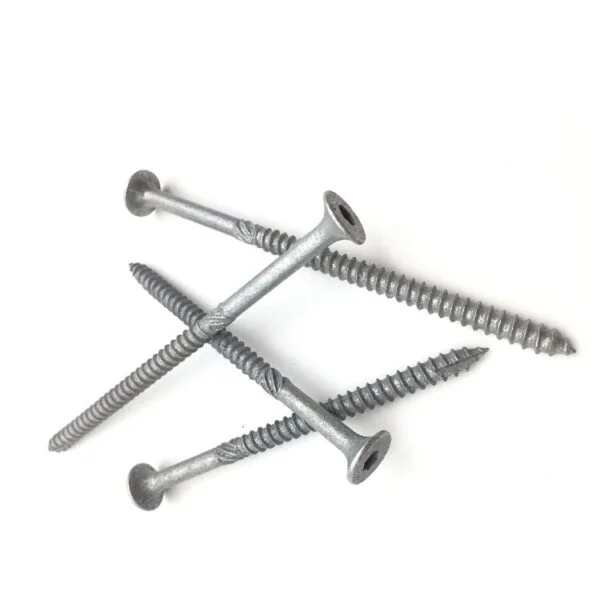
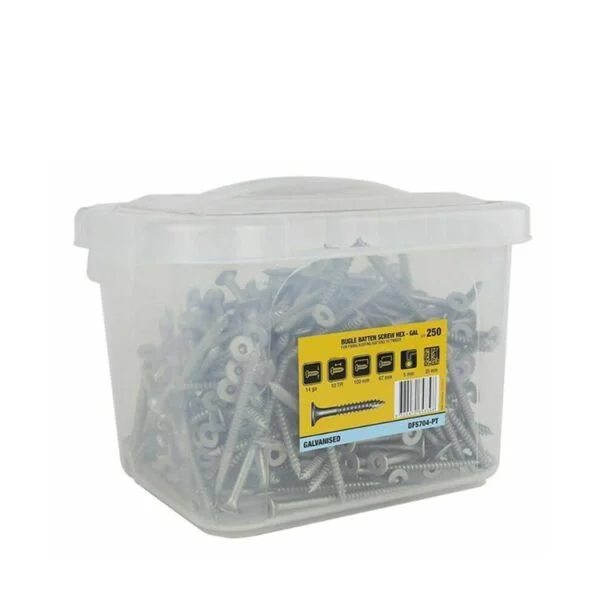
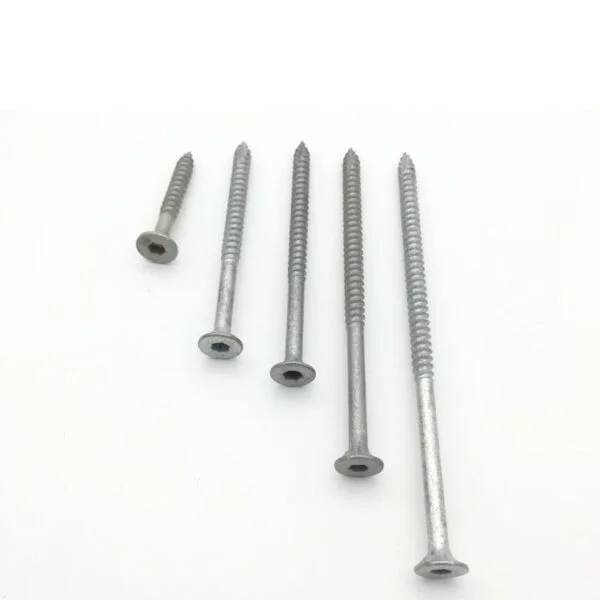
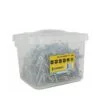
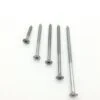
An AS3566 bugle head batten screw is the standard timber-to-timber fixing for securing roof battens to rafters and trusses, and wall battens to timber framing. The bugle batten head, Type 17 cutting point and coarse 14g-10 thread let the screw pass through the batten and bite firmly into the supporting timber, usually without pre-drilling.
Linkworld supplies bugle head batten screws in the common Australian lengths from 50 to 200 mm, in the Class 2, Class 3 and Class 4 corrosion grades the market uses for batten screws, with 5 mm hex socket or Torx drive. Other lengths can be made to your drawing or sample, in bulk cartons or your own branded packs.
Batten Screw Specifications
| Specification | Configuration |
|---|---|
| Product | Bugle head batten screw |
| Thread | 14g-10 (14 gauge, 10 threads per inch) |
| Common lengths | 50, 65, 75, 100, 125, 150 and 200 mm |
| Head | Bugle batten head, approx. 14 mm diameter |
| Point | Type 17 (T17) milled cutting point |
| Drive | 5 mm hex socket or Torx |
| Material | Hardened carbon steel |
| Corrosion grade | Class 2, Class 3 or Class 4 |
| Other lengths | Made to drawing or sample |
| Packing | Bulk cartons, own-brand boxes, buckets and small packs |
Where Bugle Batten Screws Are Used
- Roof battens fixed to timber rafters and trusses
- Wall battens and furring fixed to timber wall frames
- Outdoor timber structures such as pergolas and fence framing, for timber-to-timber connections
- Treated pine connections, with the coating chosen to suit the timber treatment
Why the Bugle Head and Type 17 Point Matter
- Bugle head: the curved underside spreads the load and draws the head down flush with the batten face, without crushing or splitting the timber the way a flat countersunk head can.
- Type 17 point: the slotted, milled tip cuts its own pilot hole as it drives. In most softwoods this removes the need to pre-drill and reduces splitting near board ends.
- Coarse 14g-10 thread: ten threads per inch give fast driving and strong withdrawal resistance in pine and hardwood rafters.
- Hex or Torx drive: the 5 mm hex socket is the traditional batten-screw drive. Torx is increasingly requested because the bit engages more securely and is less likely to cam out on long screws.
Choosing the Corrosion Grade
In the Australian and New Zealand market, batten screws are sold by corrosion grade using the Class 1 to Class 4 designations that come from the AS 3566 series, where a higher number means greater corrosion resistance. We supply Class 2, Class 3 and Class 4 grades, with the coating specification agreed with each customer.
As a general guide:
- Class 2 suits protected and internal work.
- Class 3 is the common choice for external batten fixing.
- Class 4 is used for more severe exposure, such as sites close to the coast or in heavy industrial areas.
For treated pine, check the timber supplier’s recommendation for fastener coating, as preservatives can increase corrosion of metal fasteners when moisture is present. Final selection for a roof or wall system should follow the roofing or cladding manufacturer’s fixing guide.
Common Purchasing Mistakes
Choosing the grade by appearance. Class 3 and Class 4 screws can look much the same in a carton. State the grade on every order line and every pack label.
Choosing length without checking penetration. A screw that only just passes through the batten does not hold. Allow for the batten thickness plus the penetration required into the rafter, truss or stud.
Using batten screws on decking boards. Batten screws are designed for battens and framing. Decking boards need purpose-designed decking screws.
Mixing drives and grades under one stock code. Hex and Torx versions, or Class 3 and Class 4 versions, of the same size should each have their own item code and label, to avoid picking and installation errors.
What to Send with Your Enquiry
| Item | What to tell us |
|---|---|
| Size | 14g-10 and the lengths you need; a drawing or sample for other lengths |
| Corrosion grade | Class 2, Class 3 or Class 4 |
| Drive | 5 mm hex socket or Torx |
| Quantity | Quantity for each size and grade |
| Packing | Bulk carton, own-brand box, bucket or small pack, with label details |
| Destination | Destination port |
Packing and Supply for Distributors
We pack in bulk cartons for trade distribution, or in your own branded boxes, buckets and small packs for retail. Each size, drive and grade can carry its own label. For customers who plan several deliveries through the year, we offer free warehouse storage and staged shipments.
Work With Linkworld
Linkworld has more than 20 years of fastener export experience and runs its own cold heading workshop. Our own QC team checks head form, point, thread and coating in our inspection room before every shipment. We also make custom fasteners to drawing or sample, so non-standard batten screw lengths and head markings are welcome.
Frequently Asked Questions
What is an AS3566 screw?
AS 3566 is the Australian standard series for self-drilling screws used in building and construction. In the batten screw market, “AS3566” is used together with a corrosion grade, such as Class 3 or Class 4, to describe the level of corrosion protection.
What does 14g-10 mean?
It describes a 14 gauge screw with 10 threads per inch. The gauge sets the nominal diameter, and the thread count sets how coarse the thread is.
What is the difference between Class 3 and Class 4 batten screws?
Class 4 has higher corrosion resistance than Class 3. Class 3 is common for general external batten fixing, while Class 4 is chosen for coastal, industrial or other more demanding exposure.
Hex or Torx drive for batten screws?
The 5 mm hex socket is the traditional choice and fits the bits most installers already carry. Torx gives better bit engagement and less cam-out. We supply both, clearly marked on the pack.
Can bugle batten screws be used for decking boards?
They are not recommended. Use purpose-designed decking screws for decking boards.
Looking for bugle batten screws in your own size or pack? Send the size, corrosion grade, quantity and packing you need through the enquiry form below, and our team will reply with the options that fit your range.
Send an Enquiry
Send a drawing, sample or clear reference photo. Add the quantity and application if available, and we can start from the information you already have.