

Wedge Anchor Pull-Out Tests: How to Evaluate Concrete Anchor Performance
A wedge anchor pull out test takes place on site after installation. A pulling rig applies a steady axial load to an anchor set in concrete. The test records how the anchor behaves as the load rises. The result tells a buyer whether that anchor held firm or failed in that concrete, and how it failed. It does not give a safe working load for every job or replace design. Therefore, read the test method and the failure mode beside the result.
Key points
- First, a pull-out test shows how one installed anchor behaved in stated conditions, not a safe working load for every job.
- Second, the failure mode matters as much as the result, because it shows which part of the system needs attention.
- Third, ask your supplier for the test method, the failure mode, the test conditions and a sample before you order.
What is a wedge anchor pull out test?
A wedge anchor pull out test pulls an installed anchor straight out of the concrete. The rig sits on the concrete surface and pulls through a threaded adaptor. Load rises in stages while the tester watches for movement, slip and cracking. The test ends at failure, at a set proof load, or at an agreed movement limit.
A proof test applies a set load and checks that the anchor holds it without excessive movement. A test to failure keeps loading until something gives way and shows the weak point in that installation. Ask whether the tester ran a proof test or a test to failure before drawing conclusions.
The term tension test is broader than a pull-out test. A tension test can cover a steel bar, a bolt, or a complete anchor assembly in a laboratory far from any concrete. By contrast, a wedge anchor pull out test is narrower: an anchor installed in concrete, pulled axially after installation. A laboratory tension result for a steel bar says little about how the same steel behaves in a drilled hole.
Documents such as ASTM E488 and ACI 355.2 commonly describe test methods for installed anchors. They are not a guarantee for any one product. When a supplier quotes a result, ask which method the tester used and how the anchor failed.
How does a wedge anchor fail in a pull out test?
A wedge anchor can fail in several ways, and each mode points to a different weak point. However, a stronger steel rod will not help if the concrete gives way, and deeper embedment will not help if the clip slips.
Steel fracture is the first mode. The rod breaks, usually at the threaded section or at the cone, because the steel has reached its limit. It can also show that the installation was sound, because the anchor held in the concrete long enough for the steel to fail first.
Clip slip, sometimes called pull-out, is the second mode. The clip loses its grip on the wall of the hole, and the anchor slides out while the rod stays intact. For example, a hole that is too wide gives the clip little to bite into. Dust left in the hole sits between clip and concrete and has the same effect. In addition, low installation torque can leave the clip under-expanded.
Concrete cone failure is the third mode. A cone-shaped piece of concrete breaks away around the anchor as the rig pulls it out. For example, shallow embedment gives a small cone that breaks out early. Low strength concrete gives the same result at a deeper embedment. Edge distance matters too, because a cone that reaches a free edge has less concrete to resist it.
Splitting is the fourth mode. The concrete cracks apart around the anchor, often from the hole to a nearby edge or the next anchor. It is common where anchors sit close to an edge, close together, or in thin concrete.
A test report should name the failure mode in plain words, or the buyer cannot tell which part of the system needs attention.
What affects pull-out results?
Pull-out results respond to the concrete, the hole, the installation, and the test set-up.
Concrete, embedment and the hole
Concrete strength and condition come first. Stronger concrete resists cone failure better than weaker concrete, and cracked concrete behaves differently from sound concrete. A crack through the anchor location reduces the grip on the clip and opens a path for the cone. Age matters too, because concrete gains strength as it cures. As a result, ask for the concrete strength and age, and whether cracks ran through the anchor location.
Effective embedment depth comes next. The depth below the surface sets the size of the concrete cone and the length of clip in contact with the hole. Deeper embedment gives a larger cone and more resistance. Count the effective depth, not simply the length of the rod.
Hole diameter and cleaning also change the result. A wedge anchor relies on the clip pressing against the wall of the hole, so the hole must match the anchor size. For instance, an oversized hole leaves a gap the clip cannot close. Dust in the hole acts as a cushion between clip and concrete and reduces the grip in the same way. Clean the hole with a brush and air before installation.
Torque, cone and test set-up
Installation torque sets the initial expansion. Tightening the nut draws the cone into the clip and forces the clip against the hole wall. Too little torque leaves the clip loose, and the anchor can slip under load. On the other hand, too much torque can damage the thread, stretch the rod, or crack the concrete. Follow the torque value given for that anchor.
Cone and clip design also play a part. The cone angle sets how far the clip expands, and the clip shape sets how the load spreads.
Edge distance and spacing limit the concrete available to resist the load. An anchor near a free edge has a smaller cone on one side. Anchors placed close together can have cones that overlap.
The test set-up itself can change the result. The reaction frame must stand clear of the anchor. If it presses on the concrete cone, the result looks better than it should.
Material strength is not anchor capacity
These two quantities are different. Material strength describes the steel itself, usually as a tensile strength for the grade. Anchor capacity describes the whole installed system: steel, clip, cone, hole, concrete, embedment, edge distance and spacing together. The steel can be strong while the system is weak, because the concrete or the clip fails first.
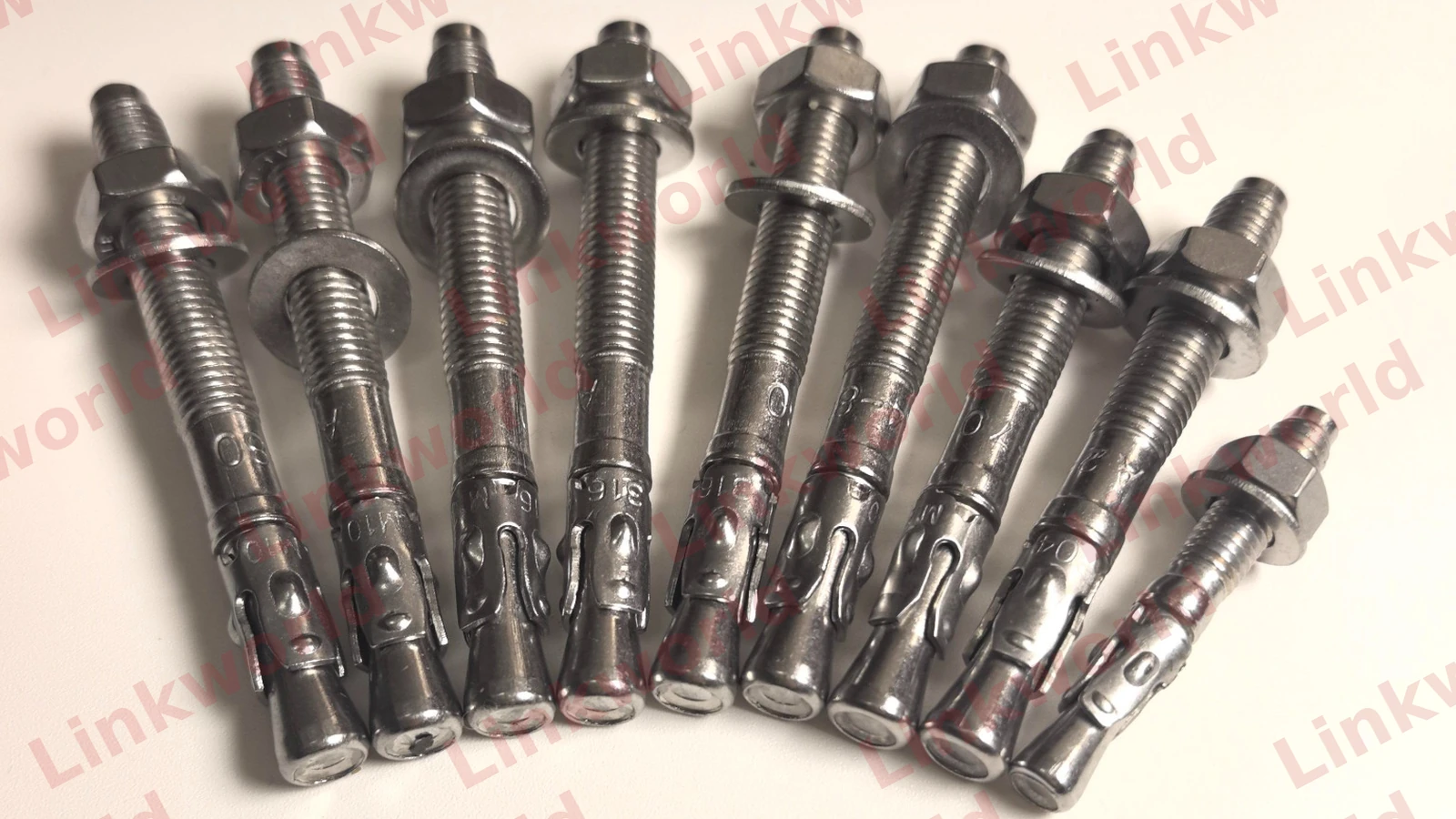
A 316 stainless steel wedge anchor illustrates the point. The rod, clip, nut and washer in the Linkworld anchor are all 316 stainless steel. The anchor is available in grades A4-70 and A4-80. The grade describes the steel. It does not, on its own, state the load that an installed anchor will carry in a given slab. A higher grade lifts the steel limit, not the concrete limit.
Why ultimate load is not a design value
Ultimate load is also different from allowable working load and from design capacity. Ultimate load is the load at which the system fails in a test. Allowable working load is a lower value, set by applying a safety factor and by considering the conditions of the job. Design capacity is the value an engineer uses for a specific project, allowing for the conditions of the project. A supplier figure without a safety factor is not a design value, and no one should use it as one.
What a wedge anchor pull out test cannot tell you
For that reason, do not take a supplier figure at face value and use it directly as a design load. The figure may come from strong, uncracked concrete at deep embedment, in the middle of a slab. A real job may have weaker concrete, a shallow embedment, or an anchor near an edge. In practice, the project engineer should confirm the design value for the actual conditions.
Manufacturing method is part of the same picture. Linkworld fully cold-heads the rod of this 316 wedge anchor in its own cold heading workshop and rolls the thread rather than cutting it. The method affects the rod. It does not, on its own, fix the concrete, the hole, or the installation.
What to ask your supplier
First, ask about the test. Ask which test method the tester used, whether the tester ran a proof test or a test to failure, and how the anchor failed. Also ask for the concrete strength and age, the embedment depth, the edge distance and spacing, and the hole diameter and cleaning method. A single figure with no conditions is a number that no one can check.
Second, ask about the product and its limits. Ask which parts use 316 stainless steel and which grades and sizes the supplier offers. Linkworld supplies this anchor in sizes from M6 to M20, in grades A4-70 and A4-80. The rod, clip, nut and washer are all in 316 stainless steel. 316 stainless steel suits some chloride-bearing environments better than 304. It does not suit every seawater, swimming pool or high-chloride environment, so the right choice depends on the exposure.
Third, ask for a sample and confirm the order terms. A sample lets the buyer check the finish, the clip, the cone and the thread before committing to a bulk order. Linkworld offers free samples of this anchor. The minimum order quantity is 300 kilograms, and the lead time is 40 to 60 days. Packaging is available in bulk or made to the customer brand. Confirm size mix, quantity, packaging and delivery in writing before ordering.
Frequently asked questions
What does a wedge anchor pull out test prove?
A wedge anchor pull out test proves how one installed anchor behaved in one set of conditions. The result applies to the day of the test. It shows whether the anchor held or failed, and how it failed. It does not prove a safe working load for every job, since the concrete, embedment, edge distance and installation can all differ.
Why did two anchors of the same size give different results?
The anchors may come from tests in different concrete, at different embedment depths, or with different installation torque, hole size and cleanliness. Set-up can also differ. In each case, the failure mode usually shows which factor changed. Compare the full test conditions before comparing the results.
Can a wedge anchor pull out test replace design?
No. A pull-out test is a check on an installed anchor in stated conditions. Design takes the test information together with safety factors, load combinations, edge distance, spacing, and the rules for the project. It is the responsibility of the engineer for the project. As a result, a test result is an input to that work, not a replacement for it.
What should I send with an enquiry for 316 stainless steel wedge anchors?
Send the size and grade, the quantity, and the packaging you need. Add the concrete and exposure conditions, plus the embedment depth and edge distance where known. Linkworld supplies sizes from M6 to M20 in grades A4-70 and A4-80. The minimum order is 300 kilograms, and the lead time is 40 to 60 days. Samples are free, and packaging is bulk or customer-brand. See the guide to types of concrete anchors for a fuller introduction, and the 316 stainless steel wedge anchors product page for the product itself.
Send an Enquiry
Send a drawing, sample or clear reference photo. Add the quantity and application if available, and we can start from the information you already have.