
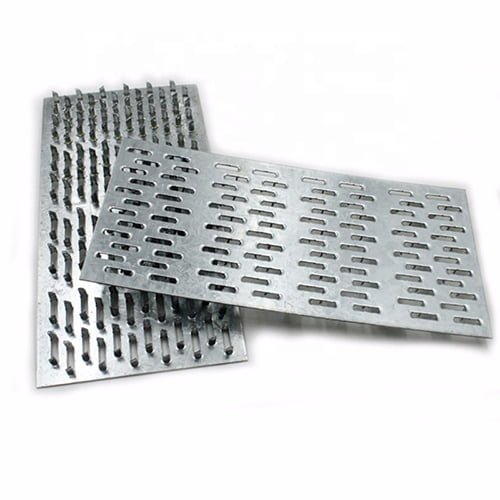
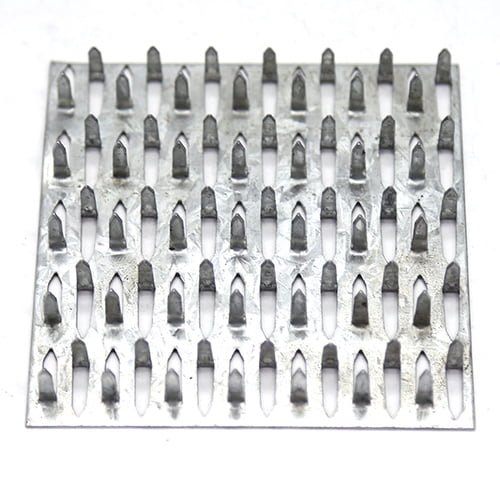
Truss nail plates are pressed steel connector plates with integral teeth, used to join timber members at the joints of roof trusses, floor trusses and prefabricated wall frames. The plate is pressed into both faces of the joint so that the teeth grip each timber member and hold the joint together without loose nails or bolts.
Linkworld supplies truss nail plates in G300 Z275 galvanised steel and in stainless steel, in thicknesses from 1.0 to 2.0 mm. Plate size, thickness, tooth height and coating can be made to your drawing or sample, and we pack in bulk cartons or in your own branded boxes for distributors, truss plants and frame manufacturers.
Truss Nail Plate Specifications
| Specification | Configuration |
|---|---|
| Product | Truss nail plate / timber connector plate with integral teeth |
| Material | G300 Z275 galvanised steel; stainless steel |
| Thickness | 1.0 to 2.0 mm |
| Coating | Z275 pre-galvanised; hot-dip galvanised or electro-galvanised on request |
| Plate size | Made to drawing or sample |
| Tooth height and pattern | Made to drawing or sample |
| Options | Custom hole patterns and logo embossing |
| Packing | Bulk cartons, own-brand boxes, tubs and small packs |
Other sizes and finishes can be made to drawing or sample.
Where Truss Nail Plates Are Used
- Timber roof trusses made in truss plants for residential and light commercial buildings
- Floor trusses and parallel-chord timber trusses
- Prefabricated wall frames and timber panel assemblies
- Timber splices and joint repairs in framing and workshop assemblies
Choosing the Right Nail Plate
- Material and coating: G300 Z275 galvanised steel is the usual specification for timber connectors in Australia and New Zealand. Stainless steel is chosen for more corrosive exposure or when the project calls for it.
- Thickness: thicker plates are used for larger timber sections and heavier joints. State the base metal thickness on every order.
- Tooth height and layout: these decide how the plate seats into the timber, so they should always match your approved drawing or sample.
- Plate size: width and length follow the truss design. Keep one item code per size so plants do not mix plates on the press line.
Plate selection for a structural truss should follow the truss designer’s specification.
Common Purchasing Mistakes
Ordering by width and length only. Two plates of the same size can have different thickness and tooth patterns. Always include the thickness and a drawing or sample.
Writing “galvanised” without the coating class. State G300 Z275, or the hot-dip or electro-galvanised finish you need, so the steel grade and zinc coating are both clear.
Mixing truss plates with nail-on plates. Truss nail plates are pressed in with a press. Nail-on plates are fixed with nails through pre-punched holes. They are different products and should be ordered separately.
Leaving packing details until the end. Truss plants usually want bulk cartons by size, while retail buyers want small packs with labels. Agree the packing format with the order.
What to Send with Your Enquiry
| Item | What to tell us |
|---|---|
| Size | Plate width, length and thickness; a drawing or sample for tooth pattern |
| Material | G300 Z275 galvanised steel or stainless steel |
| Finish | Z275 pre-galvanised, hot-dip galvanised or electro-galvanised |
| Quantity | Quantity for each size |
| Packing | Bulk carton, own-brand box, tub or small pack, with label details |
| Destination | Destination port |
Packing and Supply for Distributors
We pack truss nail plates in bulk cartons for trade distribution, or in your own branded boxes, buckets and small packs for retail. Each size can carry its own label. For customers who plan several deliveries through the year, we offer free warehouse storage and staged shipments.
Work With Linkworld
Linkworld has 18 years of fastener export experience and runs its own cold heading workshop. Our own QC team checks plate size, thickness, tooth form and coating in our inspection room before every shipment. We make stamped parts to drawing or sample, so custom plate sizes, hole patterns and embossed logos are welcome.
Frequently Asked Questions
What are truss nail plates used for?
They join timber members at the joints of roof trusses, floor trusses and wall frames. The integral teeth are pressed into the timber on both sides of the joint.
Are truss nails the same as truss nail plates?
Many buyers search for “truss nails” when they mean nail plates. A truss nail plate is a steel plate with teeth punched from the plate itself, so no separate nails are needed.
What material are timber nail plates made from?
The usual specification in Australia and New Zealand is G300 Z275 galvanised steel. We also make nail plates in stainless steel.
What thickness are nail plates for trusses?
We make truss nail plates from 1.0 to 2.0 mm thick. The thickness should follow the truss design and be stated on the drawing or order.
Can you make nail plates for wood to our drawing?
Yes. Plate size, thickness, tooth height, hole pattern, coating and logo embossing can all be made to your drawing or sample.
Looking for truss nail plates in your own sizes or packs?
Send the plate sizes, material, quantity and packing you need through the enquiry form below, and our team will reply with the options that fit your range.
Send an Enquiry
Send a drawing, sample or clear reference photo. Add the quantity and application if available, and we can start from the information you already have.